Across Europe, nationalism and conspiracy theories are becoming increasingly intertwined, shaping political narratives, influencing public opinion and challenging the foundations of European integration. From the portrayal of European institutions as distant and unaccountable elites to the promise of restoring a supposedly glorious national past, nationalist movements frequently draw on narratives of distrust, fear and resentment to mobilise political support. In an international environment marked by geopolitical tensions, economic uncertainty and growing scepticism towards multilateral institutions, these narratives raise fundamental questions about the future of democracy and European cooperation.
Why are nationalist and conspiratorial narratives so effective in mobilising citizens? How do economic insecurity, social transformations and distrust towards political institutions contribute to their appeal? And can European federalism offer a convincing alternative to nationalist rhetoric without simply defending the existing political order?
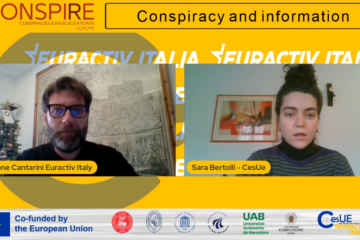
These questions are explored in an interview with Domènec Ruiz Devesa, President of the Union of European Federalists (UEF), former Member of the European Parliament for Spain’s Socialists and Democrats, and former member of Josep Borrell’s cabinet during his tenure as EU High Representative for Foreign Affairs and Security Policy, conducted by Sara Bertolli, journalist at Focus Europe Italia, within the framework of the European project CONSPIRE – CONSPIracism and RAdicalisation Risks in Europe.
Funded by the Erasmus+ programme and coordinated by the University of Turin, CONSPIRE brings together European universities and CESUE/Focus Europe to investigate conspiracy theories and radicalisation risks while developing innovative educational approaches to strengthen critical thinking, media literacy and democratic participation. Running from 2024 to 2027, the project combines academic research, non-formal education, participatory workshops and community engagement. This interview is part of the Conspiracy Pills, a series of contributions from academics, journalists and professionals designed to help students and wider audiences understand the social and political mechanisms behind conspiratorial thinking.
Drawing on his experience in European politics and federalist advocacy, Ruiz Devesa examines the socioeconomic conditions that make nationalist narratives particularly persuasive. Deindustrialisation, the decline of rural communities, economic globalisation and anxieties surrounding migration have generated feelings of insecurity and dissatisfaction among different sectors of European society. According to Ruiz Devesa, nationalist and Eurosceptic movements often exploit these concerns by identifying convenient scapegoats, from migrants to allegedly powerful globalist elites, rather than addressing the structural causes of social and economic difficulties.
A central theme of the conversation is the tension between national sovereignty and the need for collective European action. Ruiz Devesa challenges the idea that returning to absolute national sovereignty could provide effective solutions to contemporary problems. In an interconnected world, challenges such as international trade, environmental protection, security and geopolitical competition cannot be adequately addressed by individual European states acting alone. European cooperation, he argues, is therefore not merely an ideological preference but a practical necessity.
The interview also explores the implications of Donald Trump’s return to the White House, the growing influence of nationalist leaders and the weakening of international cooperation. Particular attention is devoted to the role of disinformation and propaganda as instruments of geopolitical influence. Ruiz Devesa warns that authoritarian powers can exploit information manipulation to undermine democratic institutions, influence political orientations and weaken European unity without necessarily resorting to direct military confrontation.
Beyond examining the risks associated with nationalism and conspiracy narratives, the discussion raises a broader question about Europe’s role in defending a rules-based international order. In a world increasingly shaped by competition between major powers, Ruiz Devesa presents European integration and multilateral cooperation as essential instruments for preserving democratic sovereignty, international law and political stability.
Ultimately, the interview highlights how countering nationalist conspiracy narratives requires more than exposing misinformation: it also demands credible political alternatives capable of responding to citizens’ genuine concerns and rebuilding trust in democratic institutions.
In line with the objectives of CONSPIRE, this conversation offers an important perspective on the connections between conspiratorial thinking, political polarisation and democratic resilience. By examining how nationalist narratives emerge, why they resonate with parts of society and how they can be challenged, the interview encourages a deeper reflection on the importance of critical thinking, European solidarity and informed democratic participation in shaping Europe’s future.